
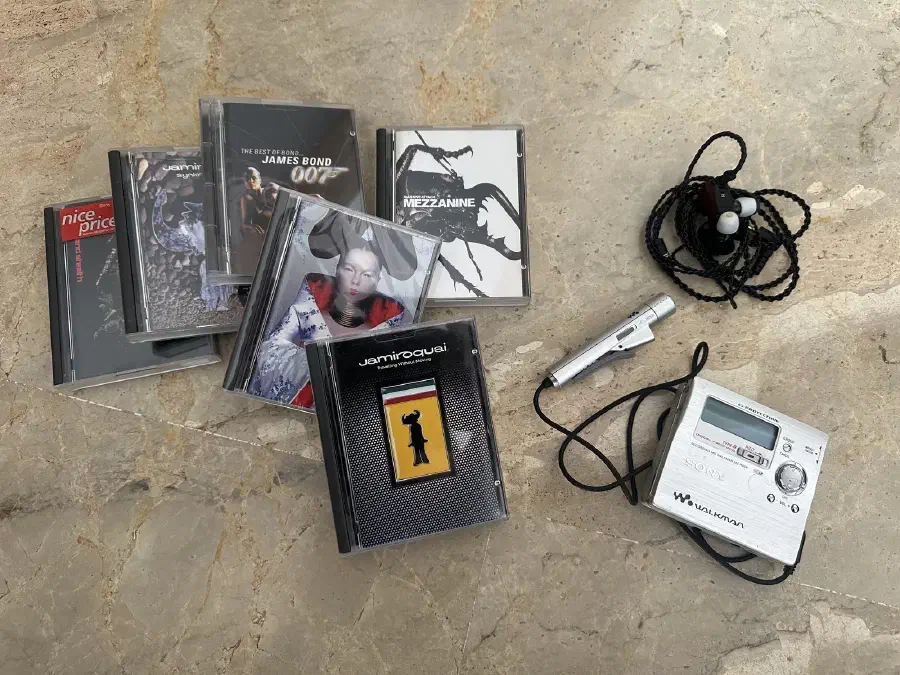
Last week whilst packing to move I found my old Sony MZ-R909 MiniDisc recorder in a box, charged it up, connected it to my Mac and accidentally disappeared down a complete retro-tech rabbit hole.
The funny thing about MiniDisc in 2026 is that it shouldn’t really make sense any more.
Spotify exists and does lossless. Apple Music exists and does lossless. YouTube exists (but has annoying adverts and does not do lossless). Every possible album is available instantly, infinitely, algorithmically, with no friction at all, so why add it?
And yet I think that’s partly why MiniDisc suddenly feels so good again.
Because sometimes friction matters.
TOO MANY CHOICES!
Digital consumption feels weird now. Infinite movies, music, books and computer games instantly. Overchoice is a very real problem now. Life was certainly more meaningful when I could only afford a CD or computer game once every couple of months and also more fun and engaging as you would swap media with friends.
I don’t think humans were designed to have access to effectively every song ever recorded, at all times, on demand, whilst simultaneously being fed algorithmic recommendations optimised for engagement metrics by trillion dollar companies.
You stop listening to albums. You stop sitting with music. You stop playing games. Everything becomes background noise.
How many times have you spent longer in front of Netflix looking for what you want to watch for dinner, than the dinner itself?
MiniDisc forces the opposite behaviour.
You have to physically choose an album. Or a mix. Or a mood. You’re constrained by volume and weight.
You record it intentionally, often in real time, title the tracks with a shitty little jog wheel interface, then carry that exact collection around for the next week or month.
Constraints become part of the enjoyment.
MiniDiscs are a blend of audio quality, nostalgia, context, memory, deliberate listening and the physical ritual of it all. And with some high quality IEMs like the TRUTHEAR x Crinacle Zero sound really fucking good.
Also for us mid 40s guys, they are the 2020s version of the 80s midlife crisis sports car with no monthly payment but worse batteries.
Honestly.. perfect 😀
The Sony MZ-R909 Is Still Awesome
The recorder I found was my old Sony MZ-R909.
And weirdly, it still absolutely rules.
The R909 sits in a sort of sweet spot in MiniDisc history. Before NetMD software got weird and restrictive, before everything became hyper-miniaturised and fragile, but after ATRAC Type-R recording became genuinely very good.
It was one of Sony’s flagship portable recorders from around 2001 and still feels incredibly well engineered today:
- magnesium + aluminium body
- proper physical controls
- optical input
- fantastic battery life
- ATRAC Type-R encoding
- built like an absolute tank, important for me as I treat things like tools..
MiniDisc hardware from this era had a kind of optimism to it. Companies were trying insane engineering experiments because consumer electronics margins were massive and the future still felt exciting.
The thing that still blows my mind is how physical it all feels.
The disc clicks in. The mechanism spins up. The TOC writes at the end. The remote cable locks with a satisfying little click. The entire thing feels engineered rather than merely manufactured.
Modern devices feel disposable.
The MZ-R909 feels like somebody actually gave a shit.
The Problem: MiniDisc Needs Silence To Split Tracks
Once I started recording discs again, I hit an old problem almost immediately.
MiniDisc recorders can automatically create track marks whilst recording from analogue input by detecting silence between songs.
But modern digital music libraries are usually gapless or tightly sequenced, so the recorder just sees one continuous audio stream and records the entire disc as a single track.
Not ideal.
The solution is simple: insert a couple of seconds of silence after every track before sending the audio to the recorder.
Years ago somebody had already solved this problem with a foobar2000 DSP plugin called foo_dsp_silence by GitHub user zao.
The plugin is tiny and elegant:
- add silence before or after tracks
- optionally skip certain paths
- insert actual silent audio samples in the DSP chain
Perfect for MiniDisc recording workflows.
Except there was one problem.
It only worked on Windows.
And I don’t hate myself any more enough to use Windows.
So I Ported It To macOS
I use an Apple Silicon MacBook now, and foobar2000 for Mac has become surprisingly decent recently, especially combined with Web MiniDisc.
So I forked the project: rushughes/foo_dsp_silence
The goal was simple:
make a proper native .component build for foobar2000 v2 on macOS.
Not a hack. Not Wine. Not a wrapper. An actual native component.
The funny thing was that the core DSP logic was already almost completely cross-platform by accident. The original plugin was basically:
- DSP logic
- config serialisation
- one Windows dialog
The audio side itself was clean C++.
The real challenge turned out to be understanding how the foobar2000 macOS SDK actually works, because it’s very different from Windows and I’m not really a Mac developer..
Instead of .dll files, Mac components are proper .component bundles with:
- Mach-O binaries
- Info.plist
- Resources
- code signatures
- Cocoa UI views
The SDK also expects Xcode projects directly rather than CMake for the Mac side, so instead of fighting the ecosystem and trying to force some horrible cross-platform abstraction layer, I decided to mirror the official sample plugin structure almost exactly.
This was one of those engineering moments where the right decision became obvious pretty quickly: Follow the platform conventions.
So the final approach became:
- keep the original Windows build untouched
- add Apple-specific code behind
#ifdef __APPLE__ - use a native Cocoa
NSViewController - create a parallel Xcode workspace
- output a real signed
.component
And somehow the first actual build attempt produced a working binary immediately, which almost never happens 😀
Why I Still Love Nerdy Stuff Like This
One thing I realised recently is that I’ve spent a huge amount of my life trying to optimise friction out of everything.
Faster. More scalable. More automated. More efficient. More leverage.
And that’s useful right up until the point where it removes all texture from your life.
MiniDisc is basically the opposite philosophy.
It is:
- slower
- less convenient
- lower capacity
- physically constrained
- intentionally finite
Which is exactly why it feels good.
You don’t endlessly skip tracks because skipping is mildly annoying. You don’t doomscroll playlists because there are only 74 minutes available. You don’t spend 45 minutes paralysed by choice because you physically only brought one disc with you.
The constraints create presence.
I think this is the same reason people are getting back in to:
- film photography
- vinyl
- old digital cameras
- notebooks
- mechanical keyboards
- dedicated music players
and I kind of love that. Having everything on your phone is super convenient, especially for travel, but it kind of makes everything beige.
Modern technology solved too many problems and accidentally removed parts of the human experience along the way.
Sometimes a tiny bit of inconvenience is actually healthy.
The Weird Emotional Side Of MiniDisc
Whilst browsing the forums to understand how to get this thing to work again, the other surprising thing was seeing people talk about MiniDiscs online again.
A lot of the conversations werent even really about audio formats but peoples memory of their youth.
Walking to school listening to Smashing Pumpkins. Recording live gigs secretly with tiny microphones. Late night mixtapes. Naming tracks one character at a time with a jog wheel. Feeling like you were living in the future in 2001.
There’s a small underground group collecting the discs Neo used in the Matrix whenever they hit eBay. Other people get excited recognising them from the movie Strange Days. And everyone kind of agrees the Hackers Soundtrack really should have had a MiniDisc release, including myself.
MiniDisc existed in this strange transitional era between analogue and fully digital life.
It had the physicality of tapes and CDs, but also editing, naming, reordering, non-linear access and digital recording.
In hindsight it feels less like an old audio format and more like an alternate timeline where music technology evolved differently.
Also it’s pretty cool in my opinion.
Download The macOS Port
If you’re having a budget midlife crisis and still recording MiniDiscs in 2026, you can grab the Apple Silicon foobar2000 component here:
foo_dsp_silence macOS port releases
Source code: rushughes/foo_dsp_silence GitHub repository
Original project by Zao: zao/foo_dsp_silence
Recommended setting for MiniDisc auto track splitting:
- 3000ms silence after each track
Then: foobar2000 -> audio interface -> analogue line in -> MiniDisc recorder.
Easy.